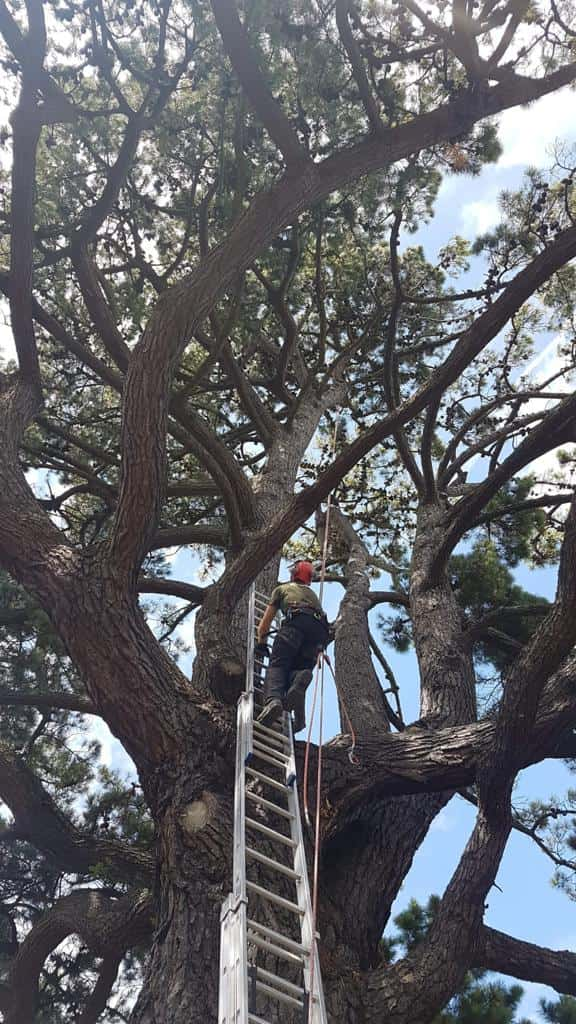
Trees can transform a garden, providing structure, shade, privacy and natural character. However, when trees become overgrown, damaged or unsuitable for their surroundings, they can also create some of the most difficult garden maintenance problems. Excessive shade, low branches, deadwood, unwanted stumps and trees that have simply become too large all require different solutions.
For property owners in Cobham, Surrey, the key is choosing the correct tree surgery service for the problem rather than simply cutting back as much growth as possible. At NS Tree Surgery Cobham, we assess the tree, its condition and its relationship with the surrounding garden before recommending an appropriate approach.
Start by Identifying the Actual Problem
Before deciding which tree service is required, it is important to establish what you want to improve.
Common concerns include:
- A tree becoming too large for its position
- Excessive shading across the garden
- Low branches restricting access
- Dead or damaged branches
- An unbalanced or excessively dense crown
- A tree requiring complete removal
- An unwanted stump occupying useful space
- Overgrown hedges reducing usable garden space
Each problem requires a different form of tree management.
Problem: The Tree Has Become Too Large
A mature tree that has outgrown its surroundings does not automatically need to be removed.
Crown reduction may provide a more appropriate solution. This involves selectively reducing the height and spread of the canopy while retaining a balanced shape.
Professional crown reduction can help where branches are extending excessively across the garden or where the overall canopy has become disproportionate to the available space.
Importantly, crown reduction is different from indiscriminately cutting the top from a tree. Careful pruning points are selected to preserve a suitable structure and natural appearance.
Problem: Your Garden Feels Too Dark
A dense tree canopy can significantly influence the amount of natural light reaching lawns, planting and outdoor living areas.
Depending on the tree, crown thinning may help.
Crown thinning involves selectively removing smaller branches throughout the canopy without substantially reducing its overall dimensions. Where appropriate, this can improve light penetration and airflow while retaining the tree’s established shape.
In other circumstances, selective pruning or crown lifting may provide a better solution. Professional assessment helps determine which approach is most suitable.
Problem: Low Branches Are Taking Over the Garden
As trees mature, lower branches can begin restricting how the space beneath them is used.
They may extend across:
- Paths
- Lawns
- Driveways
- Seating areas
- General garden space
Crown lifting involves removing selected lower branches to increase clearance beneath the canopy.
When carried out appropriately, this can make the surrounding area considerably more practical without substantially reducing the overall size of the tree.
Problem: There Are Dead Branches in the Canopy
Deadwood is relatively common, particularly in mature trees.
Branches can die naturally through ageing and competition for light, while damage or declining condition can also contribute.
Professional deadwood removal focuses on removing appropriate dead branches from the canopy. This can reduce the likelihood of weakened branches falling unexpectedly while also creating a cleaner, better-maintained appearance.
Large dead branches or deadwood positioned above frequently used areas deserve particular attention.
Problem: The Tree Looks Unbalanced
Trees do not always develop perfectly symmetrical crowns.
Surrounding buildings, neighbouring vegetation, previous pruning and competition for light can all influence growth. In some cases, one part of the crown may become significantly heavier or more extended than another.
Selective tree pruning can help manage this growth.
Rather than attempting to make the tree artificially symmetrical, professional pruning aims to improve its structure and suitability while respecting its natural form.
Problem: Branches Are Growing Towards Your Property
Branches extending towards buildings can become increasingly difficult to manage if allowed to continue growing unchecked.
Early pruning can often provide appropriate clearance while avoiding the need for much heavier cutting later.
The correct approach depends on factors such as:
- Branch size
- Tree species
- Crown structure
- Available space
- The amount of clearance required
Regular management can be particularly useful where established trees grow within relatively restricted gardens.
Problem: The Tree Is Severely Damaged or Unsuitable
Not every tree can or should be retained indefinitely.
Where a tree is significantly deteriorated, severely damaged or no longer suitable for its surroundings, professional assessment may determine that removal is the most practical option.
Tree felling may be possible where sufficient clear space exists.
Where buildings, fences, sheds or other features make conventional felling impractical, sectional dismantling can be used instead. The tree is progressively removed in manageable sections, allowing much greater control throughout the process.
Problem: An Old Stump Is Wasting Garden Space
Removing a tree does not automatically remove the stump.
An old stump can remain inconvenient for years, particularly when positioned within a lawn or an area intended for future landscaping.
Stump grinding uses specialist machinery to reduce the stump below ground level.
This can make the area easier to:
- Re-turf
- Replant
- Maintain
- Incorporate into future landscaping
- Use as practical garden space
Grinding is often the logical final stage after tree removal.
Problem: Your Hedge Has Become Too Wide or Tall
Established hedges can gradually occupy far more garden space than originally intended.
Regular hedge cutting helps maintain a controlled height, width and shape. Where a hedge has become significantly overgrown, more substantial reduction may sometimes be possible, depending on its species and condition.
Professional assessment is particularly useful with neglected hedges because not every hedge responds well to severe cutting into older growth.
Problem: You Are Unsure What the Tree Needs
Sometimes the biggest difficulty is simply knowing what work should be carried out.
A tree may look overgrown without necessarily requiring major reduction. Similarly, an apparently healthy canopy can contain deadwood or structural issues that are difficult to recognise from ground level.
A professional tree assessment considers the tree as a whole before recommending work.
This can prevent unnecessary pruning and ensure that any tree surgery has a clear purpose.
Why the Correct Tree Surgery Technique Matters
Tree surgery should solve a specific problem rather than simply make a tree smaller.
Different techniques produce very different outcomes:
- Crown reduction manages overall canopy size
- Crown thinning reduces canopy density
- Crown lifting increases clearance underneath
- Deadwood removal addresses dead branches
- Selective pruning manages individual growth
- Tree felling removes an entire tree
- Sectional dismantling enables controlled removal in restricted spaces
- Stump grinding deals with the remaining stump
- Hedge cutting controls established boundaries
Selecting the correct service helps achieve a better result while avoiding unnecessary work.
Professional Tree Surgery Can Improve the Whole Garden
Tree management can have an impact far beyond the tree itself.
Appropriate work can help create:
- More usable outdoor space
- Improved natural light
- Better clearance
- A tidier landscape
- More manageable future growth
- A better relationship between trees and surrounding garden features
This is why professional tree surgery should consider the entire garden rather than focusing solely on individual branches.
Why Choose NS Tree Surgery Cobham?
At NS Tree Surgery Cobham, we provide professional tree surgery throughout Cobham, Surrey. Our approach begins by identifying the actual problem and assessing the tree before recommending suitable work.
Our services include tree pruning, crown reduction, crown thinning, crown lifting, deadwood removal, tree felling, sectional dismantling, stump grinding and hedge cutting.
Whether you have one problematic branch or a mature tree that has become difficult to manage, careful assessment allows the work to be tailored to the tree and its surroundings rather than relying on a one-size-fits-all solution.
Conclusion
The best tree service depends entirely on the problem you are trying to solve. An oversized canopy may benefit from crown reduction, low branches can be addressed through crown lifting, dead branches may require deadwood removal, while an unwanted tree or stump may call for removal and stump grinding.
The important point is that effective tree surgery begins with correct diagnosis. Cutting branches without understanding the objective can create new problems rather than resolving existing ones.
For property owners in Cobham, Surrey, NS Tree Surgery Cobham provides professional tree surgery designed around the individual needs of each tree and garden. If a tree, hedge or stump has become one of your garden’s biggest problems, our experienced team can assess the situation and recommend the most appropriate way to manage it.
Call us on: 01372 679 098
Click here to find out more about NS Tree Surgery Cobham
Click here to complete our contact form and see how we can help with your tree needs.